François Hatot Blues’n Co. 115 Mars 2026
For the english just scroll down
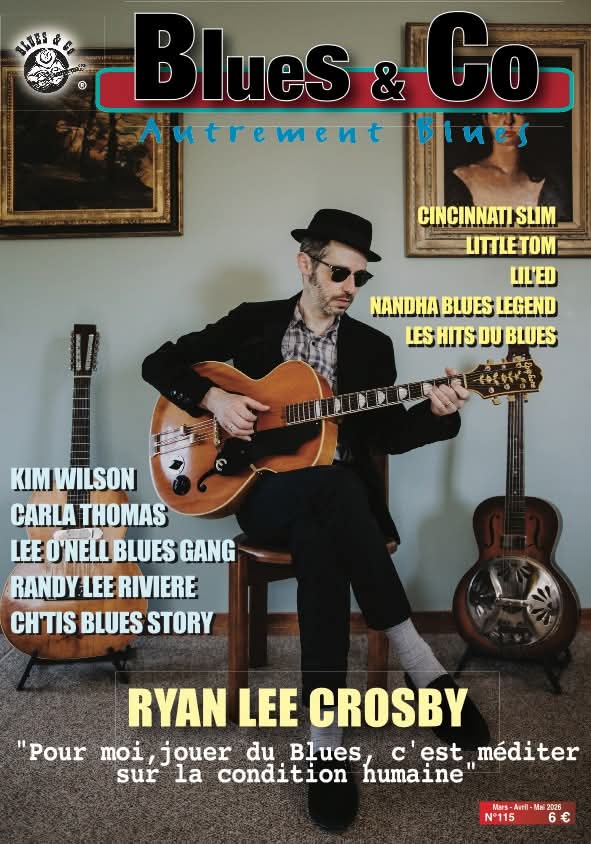
Découvert, pour ma part, cette année avec la sortie de Bentonia Blues / Right Now, l’album de Jimmy « Duck » Holmes sorti en 2025 et qu’il a enregistré sur magnétophone à bande au Blue Front Café, voici une interview de l’un des plus brillants et sensibles musiciens contemporains, converti au Hill Country Blues de Bentonia (MS) : le Bentonia Style.
Cette même année, il a également sorti At The Blue Front, un album mystique, incroyable, tendre et authentique. Musicien accompli dans d’autres styles, Ryan Lee Crosby nous offre inlassablement des albums blues originaux, empreints d’une grande sensibilité, créativité et inspiration personnelle. Cet auteur-compositeur-interprète complet, formé à la musique indienne et le plus souvent accompagné par Grant Smith et ses calebasses africaines, méritait bien quelques pages dans Blues & Co !
Cette interview exclusive retrace quelques grands moments de sa vie et de sa carrière, dans l’espoir de donner envie de l’entendre en Europe — et en France — dès que possible !
Pouvez-vous vous présenter brièvement à nos lecteurs, pour ceux qui ne vous connaîtraient pas encore ?
RLC : Ryan Lee Crosby, musicien, producteur et enseignant, je suis installé actuellement à Rhode Island, aux États-Unis. Depuis plus de quinze ans, j’étudie, je joue et j’enregistre dans le style du blues du Mississippi. Depuis 2019, je me rends régulièrement à Bentonia pour être accompagné par Jimmy « Duck » Holmes, qui m’a transmis cette tradition et m’a également fait l’honneur de me confier la production de plusieurs de ses albums.
Avant de m’engager pleinement dans l’étude du style de Bentonia, j’ai travaillé dans d’autres genres, notamment le post-punk et songwriting. J’ai également étudié la musique classique indienne pendant plusieurs années.
En tant que producteur, je suis passionné par le matériel analogique, en particulier les magnétophones quatre pistes et les équipements de studio des années 1970 et 1980. J’essaie de capter la musique de manière spontanée, aussi vivante et immédiate que possible, en acceptant les contraintes. Deux albums que j’ai produits l’an dernier ont été enregistrés en public au Blue Front Cafe de Bentonia pour mon label Crossnote Records : le CD de Jimmy « Duck » Holmes Bentonia Blues / Right Now (2025) et un vinyle sous mon nom (avec Jimmy), intitulé At the Blue Front (2025) .
Pouvez-vous nous parler de votre parcours, de vos origines, et de la façon dont le blues est entré dans votre vie, personnellement et musicalement ?
RLC : J’ai grandi dans le nord de la Virginie. Ma mère venait de Los Angeles et mon père de New York. Du côté maternel, je descends d’une lignée d’artistes (je suis la quatrième génération), et du côté paternel, d’enseignants et d’éditeurs. Les Crosby vivaient à Hollywood pendant « l’âge d’or » du cinéma, jusque dans le début des années 1970. Il y avait toujours des films et de la musique à la maison, et c’est ainsi que j’ai entendu pour la première fois John Lee Hooker, les Ramones, Sam & Dave et beaucoup d’autres choses qui ont ouvert mon esprit et mon cœur. La première chanson que j’ai écrite enfant était inspirée du blues — cela m’a parlé immédiatement.
Comme beaucoup de personnes élevées en dehors de la tradition, j’ai découvert le blues à travers le rock des années 1960, mais je n’ai jamais vraiment essayé de l’apprendre ou de le jouer avant bien plus tard, après avoir entendu les enregistrements de Skip James de 1931, ainsi que de nombreux albums du label Fat Possum. C’est à ce moment-là que j’ai commencé à étudier le répertoire d’avant-guerre avec Paul Rishell, qui m’a aussi enseigné l’accordage « crossnote » (Ndr : C’est d’où vient le nom du label de RLC, cet accordage en Mi-La-Mi-La-Do-Mi).
Je suis allé pour la première fois au Mississippi en 2014, et c’est là que j’ai entendu parler de Jimmy « Duck » Holmes. J’ai essayé de l’appeler plusieurs fois, mais je ne l’ai rencontré en personne qu’en 2019. Beaucoup de choses se sont produites dans ma vie pendant ces cinq années : j’ai tourné dans toute l’Europe en jouant du blues dans de petits clubs, j’ai étudié la musique classique indienne, j’ai enregistré quelques albums. C’est aussi à ce moment-là que j’ai commencé à travailler avec Grant. Ainsi, lorsque je suis enfin arrivé au Blue Front, j’avais déjà suffisamment vécu pour comprendre à quel point j’étais chanceux d’être là et combien le temps passé avec Jimmy était précieux.
J’ai donc continué à y retourner, deux ou trois fois par an, pour apprendre, jouer dans toute la région, et finalement enregistrer avec Jimmy en 2024. En 2025, nous avons sorti Bentonia Blues / Right Now et At the Blue Front. Nous avons également enregistré un nouvel album pour Jimmy, qui sortira plus tard en 2026.
Si vous deviez expliquer ce que le blues vous a apporté dans votre vie au-delà de la musique, que diriez-vous ?
RLC : Dans ma vie quotidienne, le blues m’a apporté un sens plus profond de l’humilité, du respect, une conscience de l’interconnexion et une appréciation sincère de ce que c’est que la communauté. Il m’a aussi donné une plus grande conscience de la complexité de la condition humaine, un sentiment particulier de peine de cœur, et la reconnaissance du fait que, partout dans le monde, il y a des blessures qui ne sont pas encore guéries.
Que signifie jouer du blues aujourd’hui ? Comment avez-vous trouvé votre place dans cet héritage sans vous sentir contraint par la tradition (choix des instruments, des musiciens, du son recherché) ?
RLC : Je ne peux parler que pour moi, mais jouer du blues aujourd’hui, c’est avoir l’opportunité de rendre le monde meilleur, car la musique nous aide à devenir de meilleures personnes. Comme le disait John Lee Hooker : « le blues est un guérisseur ». Pour moi, jouer du blues, c’est méditer sur la condition humaine — toutes ses connexions et toutes ses complications. Le blues nous aide à travailler avec toutes les émotions de la vie, toutes les couleurs de l’arc-en-ciel, les joies et les peines que nous ressentons individuellement et en tant que famille humaine.
La question de trouver sa place dans l’héritage du blues est permanente. Je ne suis pas né dans cette tradition, mais je fais confiance à la profondeur avec laquelle cette musique m’a parlé très tôt, au niveau de l’âme, et à ce lien qui ne m’a jamais quitté. Le blues est une tradition orale à l’histoire profonde, et j’ai compris que si je voulais vraiment la comprendre, j’avais besoin d’un lien avec le lieu d’où elle vient et d’un enseignement transmis par un dépositaire de cette lignée.
Le fait que je me sois connecté si profondément au son de Bentonia, que Jimmy soit encore là à jouer au Blue Front et qu’il ait accepté de m’enseigner est un miracle de ma vie que je ne peux pas expliquer. Mais je peux pratiquer la gratitude, reconnaître que nous sommes tous des maillons de la chaîne de l’humanité. Nous pouvons nous relier à ceux qui nous ont précédés de différentes manières : en écoutant des disques, en apprenant leurs histoires, en ayant un sens du lieu et de la communauté, et en étant aussi ouverts que possible dans nos relations. Et, en même temps, développer une connexion consciente à nous-mêmes et à nos propres vérités.
En résumé, mon chemin est d’apprendre la tradition avec la plus grande sincérité possible… et, ce faisant, d’apprendre qui je suis et de devenir la meilleure version de moi-même, en sachant que je ne peux être personne d’autre et que personne d’autre ne peut être moi.
Nous utilisons aussi des instruments moins courants dans la musique américaine, comme la guitare électrique douze cordes et la calebasse ouest-africaine, en partie par amour pour les légendes du blues malien Boubacar Traoré et Ali Farka Touré.
Depuis presque dix ans, je joue avec Grant Smith à la calebasse et Jay Scheffler à l’harmonica. Nous avons voyagé à travers les États-Unis et l’Europe, donné de nombreux concerts et enregistré plusieurs albums. Nous accompagnons également Jimmy sur son prochain disque prévu pour 2026. J’adore jouer avec eux parce qu’ils comprennent profondément que cette musique exige une écoute attentive et une grande profondeur de sentiment. Il n’y a pas de mesures fixes, pas de changements d’accords, tout se déploie autour du chant, un battement après l’autre, selon le ressenti. Le style de Bentonia repose sur un groove, une pulsation, et non sur une structure en douze mesures. Il faut être attentif à chaque note et à chaque battement, et prêt à s’adapter à tout moment. Jay et Grant font cela avec une grande aisance, ce qui me permet d’aller là où la musique nous entraîne. Quand nous jouons ensemble, nous n’interprétons pas une chanson : la musique nous traverse. C’est un processus de réception.
Le son que nous recherchons est intemporel. Celui du vieux blues et de l’époque que Jimmy appelle celle des « anciens », un son qui continue de toucher les gens aujourd’hui parce qu’il est vrai. Pas d’IA, pas de filtres, pas de surproduction.
En tant que musicien mais aussi producteur, cela signifie des amplis à lampes, des machines à bande, du matériel vintage, et surtout une interprétation à cœur ouvert, que ce soit en studio, sur scène ou sur le terrain.
Pouvez-vous décrire votre processus créatif, de la première idée à la version finale d’un morceau ?
RLC : Cela commence souvent par quelque chose que Jimmy m’a montré, ou par ce que j’ai vu jouer chez un musicien que j’admire (certains de mes morceaux sont nés en jouant avec RL Boyce ou en voyant Robert Belfour jouer de très près). Cela peut aussi venir d’un disque que j’ai écouté, ou simplement d’une idée qui surgit en jouant… ou même lorsque je pense à autre chose, comme en conduisant. Ensuite, il y a un mélange d’enregistrements de maquettes, de concerts, et le morceau se déploie peu à peu vers ce qu’il veut devenir, avec le temps. Je trouve qu’ils continuent souvent d’évoluer au fil des années et qu’ils ne sont jamais vraiment « terminés ».
Que représente la scène pour vous et comment se crée le lien avec le public ?
RLC : La scène est pour moi une porte entre le plan physique et le plan spirituel… et le public en détient la clé. La musique est le canal par lequel l’esprit se manifeste, sous forme de sensations et de sons, et l’énergie ainsi que l’ouverture du public facilitent cela. Plus la connexion avec le public est forte, plus la musique peut être à son meilleur. Je pense que cela atteint son apogée lorsque la connexion est non verbale et qu’il n’y a pas trop de paroles entre les morceaux.
Quelle est votre actualité et dans quelle direction allez-vous ?
RLC : Je me vois avancer sur deux chemins parallèles : continuer à approfondir ma compréhension et ma pratique du blues dans une perspective traditionnelle, et en même temps réunir toutes les influences qui m’ont marqué au fil des années — du blues au punk, du songwriting jusqu’à la musique électronique — dans l’espoir de cultiver quelque chose de respectueux et sincère, mais aussi totalement fidèle à moi-même. S’il y a une sagesse que je perçois chez Jimmy, c’est celle-ci : être vrai.
Quels sont vos projets pour l’avenir ?
RLC : Le prochain projet est un album live pour Jimmy « Duck » Holmes cette année. En parallèle, je travaille sur une série d’enregistrements maison sur cassette, inspirés du dub, du trip-hop et de la soul, tout en restant ancrés dans le style de Bentonia.
Que souhaiteriez-vous dire à nos lecteurs en France, ou aux programmateurs de festivals et de salles de concert ?
RLC : Merci de nous avoir lus — nous serions ravis de venir vous rencontrer en personne.
Merci Ryan Lee pour ta disponibilité, ta gentillesse ! Au plaisir de se voir pour de vrai prochainement en Europe !
Informations :
www.ryanleecrosby.bandcamp.com
www.instagram.com/ryanleecrosby
EN :
Discovered, at least for me, this year with the release of Bentonia Blues / Right Now—Jimmy « Duck » Holmes’ 2025 album, which he recorded on reel-to-reel tape at the Blue Front Café—here is an interview with one of the most brilliant and sensitive contemporary musicians, now devoted to the Hill Country Blues of Bentonia, MS: the Bentonia Style.
That same year, he also released At The Blue Front, a mystical, incredible, tender, and authentic album. A master of other musical styles, Ryan Lee Crosby tirelessly delivers original blues albums marked by deep sensitivity, creativity, and personal inspiration. This complete singer-songwriter, trained in Indian music and most often accompanied by Grant Smith and his African calabashes, truly deserved a feature in Blues & Co!
This exclusive interview traces key moments of his life and career, hoping to inspire audiences to experience his music live in Europe—and in France—as soon as possible!
- Can you briefly introduce yourself to our readers for the few who would not know you already ?
RLC: Ryan Lee Crosby, a musician, producer and teacher, currently living in Rhode Island, USA. For over 15 years, I’ve been studying, performing and recording in a Mississippi blues style. Since 2019, I’ve traveled to Bentonia regularly for mentorship from Jimmy “Duck” Holmes, who has taught me about the tradition and who has also blessed me to produce a number of albums with him.
Prior to committing myself to studying the Bentonia style, I worked in a number of other genres: including post-punk and singer/songwriter music. I also studied Indian Classical music for a few years, as well.
As a producer, I am passionate about analog equipment, especially 4 track tape recorders and outboard gear from the 1970s and 80s. I strive to capture music spontaneously – as live and in the moment as possible, embracing limitations. Two albums that I produced last year were recorded live at the Blue Front Cafe in Bentonia: the Jimmy “Duck” Holmes CD Bentonia Blues / Right Now and an LP under my name, (featuring Jimmy), called At the Blue Front. - Can you tell us about your journey, where do you come from and how blues music first entered your life, both personally and musically?
RLC: I grew up in Northern Virginia. My Mom was from Los Angeles and my Dad was from New York. I come from a line of entertainers on my mother’s side (I am the 4th generation) and teachers / publishers on my father’s side. The Crosbys lived in Hollywood during the “Golden Era” and into the early 1970s. There were always movies and music playing in the house and that is how I first heard John Lee Hooker, the Ramones, Sam & Dave and lots of other stuff that opened my mind and heart. The first song I wrote as a kid was an attempt at the Blues – it felt resonant to me from the beginning.
Like many people raised outside the tradition, I was turned on to a lot of Blues through rock music from the 60s, but I never tried to learn or present the music in anyway until decades later, after I heard Skip James’ 1931 recordings, as well as many of the albums on Fat Possum… and from there I began by studying pre-war repertoire with Paul Rishell, who also taught me the Crossnote tuning. I first went to Mississippi in 2014 and that’s when I first heard of Jimmy “Duck” Holmes. I tried calling him a few times, but didn’t meet him in person until 2019. Lots of things happened in my life during those 5 years in between – I toured all over Europe playing blues in small clubs, I studied Indian classical music, I made a couple of albums. That’s when I started working with Grant, too. And so by the time I finally got to the Blue Front, I had experienced enough to know how incredibly fortunate I was to be there and that the time spent with Jimmy was priceless. So I kept on going back, 2 or 3 times a year, to learn, to play throughout the region and eventually to record with Jimmy in 2024. In 2025, we put out “Bentonia Blues / Right Now” and “At The Blue Front.” We also recorded a new album for Jimmy, which will be available later on in 2026.
- If you had to explain what the blues has brought into your life beyond music, what would you say?
RLC – In my daily life, the blues has brought a deeper sense of humility, reverence, a recognition of interconnectedness and a sincere appreciation of community. It has also brought an increased awareness of the complications of being human, a particular feeling of heartache and a recognition that all across the world, that there are wounds which haven’t healed.
- What does it mean to play the blues today, how did you find your own place within that heritage without feeling constrained by tradition? (Including the choices of your instruments, the people you play with and the sound you are looking after ?)
RLC: I can only speak for myself in saying that to play the Blues today is to have an opportunity to make the world a better place, because music gives us an opportunity to become better people. As John Lee Hooker said, “the blues is a healer.” To me, to play the Blues is to meditate on the human condition – all the connections and all the complications. The blues can help us work with all the feelings of life, all the colors in the rainbow. The joys and sorrows that we feel as individuals and as a human family.
The question of how to find a place in the Blues heritage is an ongoing one. I was not born into it. But I trust in how deeply the music spoke to me on a soul level early on and that this connection has stayed with me ever since. The Blues is an oral tradition with a deep history and I knew that if I wanted to understand it to any degree that I personally needed some sense of connection in the place where it came from and to be taught by a lineage holder. The fact that I connected so deeply to the Bentonia sound and that Jimmy is still there playing at the Blue Front and that he has been willing to teach me is all a profound miracle of my life that I can’t explain… But I can practice showing my gratitude and to recognize that we are all links in the chain of humanity. And we can connect to those who came before us in different ways – by listening to records, by learning their stories… and by having a sense of place, of community and by relating as openly as we can. And as we do all this, to also develop a conscious connection to ourselves as individuals and to our own truths.
In short, the road for me is to learn the tradition as sincerely as you can… and in the process, learn who you are and be the best version of yourself… knowing that you can’t be anyone else and nobody else can be you…
We have used some instruments that are less common in American music – the electric 12 string guitar and the West African calabash – which comes in part from a love of Malian blues legends Boubacar Traoré and Ali Farka Touré.
For most of the last 10 years, I’ve been playing with Grant Smith on calabash and Jay Scheffler on harmonica. We’ve traveled all over the US and Europe performing together and we’ve made a number of albums. We also back Jimmy on his upcoming 2026 record. I love playing with them because they totally understand that this music calls for close listening and depth of feeling. There are no bar lines, no chord changes, it all unfolds around the vocal, one beat at a time, as you feel it. The Bentonia style unfolds from a groove, a pulse, there is no 12 bar progression. You’ve got to pay attention to every note and beat and be willing to adjust for any changes that come your way. Jay and Grant handle this with skill and ease, in a way that makes me feel completely supported in going wherever the music wants to go. When we play together, we’re not performing a song, the music is coming through us. It’s a process of receiving.
I think the sound we are looking for is a timeless one. We are looking for the sound of the old blues and an era of performers that Jimmy refers to as “the old timers,” but this sound continues to speak to people now because it is real. No AI, no filters, no over-production.
As a performing musician, but also a producer, this means tube amps, tape machines, vintage outboard gear and most importantly – going for an openhearted performance, whether it’s in the studio, on stage or recording in the field.
- Can you describe your creative process — how a song comes to life, from the first idea to the final version?
RLC: It will often start with something Jimmy showed me, or something I saw played by a musician I admire (some of my songs have come from playing with RL Boyce and from seeing Robert Belfour play up close). It can also start from something I heard on a record, or maybe just an idea that comes to me while playing… or even while my mind is focused on something else, like driving. And then from there, it will be a combination of making demo recordings, playing live and then letting the song kind of unfold into what it wants to be, over time. I find that they often continue to grow as the years go by and are never really “finished.”
- What does the stage represent for you, and how does the connection with the audience take shape?
RLC: The stage, for me, is the doorway between the physical and the spiritual plane… and the audience holds the key. The music is the conduit for spirit to come through, as feelings, in sound… and the energy and openness of the audience facilitates this. The more we connect with the audience, the more support there is for the music to be its best. I think it may be at its highest when the connection is non-verbal and there isn’t too much talking between the songs. - What is your actuality and in which direction are you moving forward ?
RLC: I see myself moving toward on two parallel paths – continuing to deepen my understanding and ability in the Blues from a traditional perspective… and also to keep bringing together all the sounds and styles that have influenced me over the years, from Blues to punk to singer/songwriters to electronic music… in the hopes of cultivating that which is both lovingly and sincerely respectful, but also completely true to myself. If there is one bit of wisdom that I perceive from Jimmy, it is to be true.
- What are your projects for the future ?
RLC: A live album for Jimmy “Duck” Holmes this year is the next project and while we prepare for this, I am also working on a series of home recordings on cassette that draw from dub, trip-hop and soul, as well as the Bentonia style.
- What would you like to say to our readers here in France or for the owner of blues festivals or concert venues ?
RLC: Thank you for reading – we would very much love to come see you in person.
Informations :